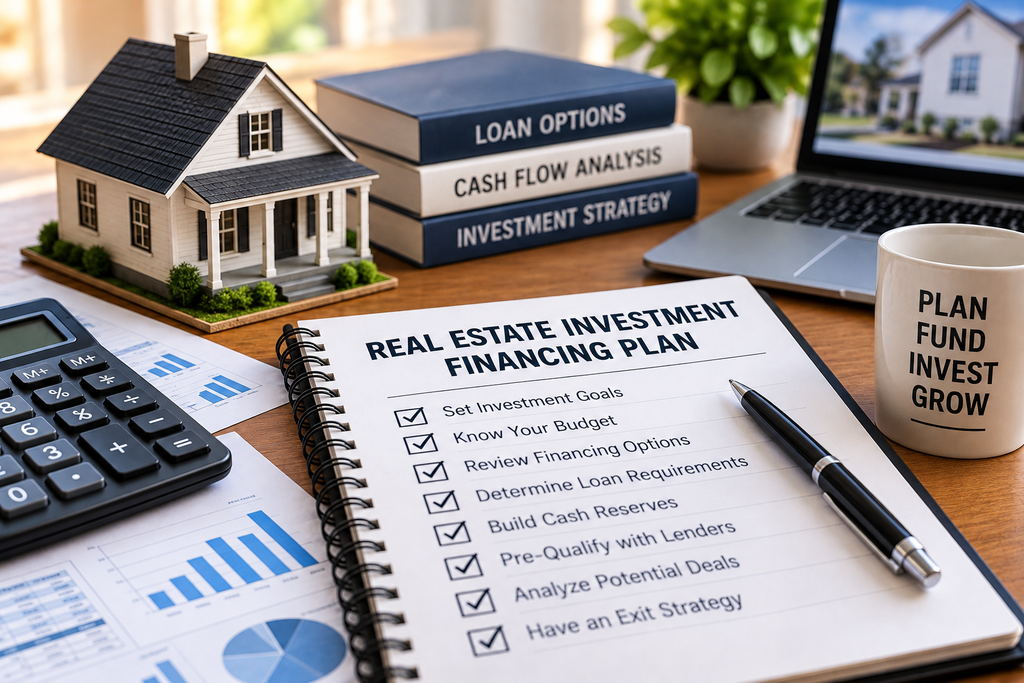
How to Build a Financing Plan Before You Find Your Next Deal
One of the biggest mistakes real estate investors make is finding a property they love before figuring out how they will pay for it.
The property looks promising. The numbers seem reasonable. You can already picture the rental income or the profit from a renovation and resale. Then the questions begin: How much cash do I need? Which lender should I contact? Can I qualify? How much will closing costs add? What happens if the property needs more repairs than expected?
These are questions you want answered before you make an offer, not when you’re racing against a closing deadline.
A financing plan helps you understand your buying power, compare funding options, protect your reserves, and move more confidently when an opportunity fits your investment goals.
Whether you’re buying your first rental property, expanding an existing portfolio, or preparing for your next fix-and-flip, here’s how to build a financing plan before you find your next deal.
Step 1: Define Your Investment Strategy
Your financing plan should begin with the kind of property you intend to buy and how you expect to make money from it.
Different investment strategies have different financial requirements.
Buy-and-hold rental properties
If you plan to own a property for several years, consider financing that supports long-term ownership. You will need to evaluate the down payment, monthly debt payments, operating expenses, reserves, and expected rental cash flow.
Potential financing options may include conventional investment-property mortgages, portfolio loans, or eligible DSCR loans.
Fix-and-flip properties
If your goal is to renovate and resell, your financing must cover more than the purchase price. You need a plan for renovation funding, interest, points, insurance, taxes, utilities, and other holding costs while the property is being improved and marketed.
Depending on the project and your qualifications, you might investigate hard money loans, private financing, or specialized renovation products.
Multifamily or larger investments
Properties with multiple units or more complex operations may require different underwriting, larger reserves, commercial financing, or specialized lenders.
Your strategy determines which financing options are worth exploring. Start there instead of assuming one loan product will work for every property.
Step 2: Determine How Much Cash You Can Safely Invest
Your available cash is not necessarily the same as the amount you should invest.
Before speaking with lenders, calculate the funds you can commit without putting your personal finances or existing investments at unnecessary risk.
Consider four separate categories:
- Purchase funds: Your expected down payment or cash contribution toward the purchase.
- Transaction costs: Closing costs, lender fees, points, appraisals, inspections, and prepaid expenses.
- Project funds: Renovations, repairs, immediate improvements, or initial property expenses.
- Reserves: Cash kept available for vacancies, repairs, overruns, unexpected expenses, and debt payments.
For example, suppose you have $100,000 available for real estate investing. That does not automatically mean you should put $100,000 into the down payment.
If the purchase, closing costs, and initial improvements consume nearly all your cash, you may have too little left to handle a problem after closing.
Decide on a reserve amount appropriate for your personal situation and the property before determining your maximum purchase budget.
Step 3: Establish Your Borrowing Profile
Before shopping for properties, learn how lenders are likely to evaluate you.
Depending on the loan program, lenders may review:
- Credit score and credit history.
- Verified income and existing debts.
- Available cash and financial reserves.
- Experience owning or managing investment properties.
- Number and performance of existing properties.
- Property type, condition, and location.
- Intended use of the property.
- Your proposed financing and repayment strategy.
Requirements vary by lender and loan product. A borrower who qualifies for one financing program may not qualify for another.
Gather the documents a prospective lender may request, such as income records, asset statements, information about existing debts, rental property records, and details about your current real estate holdings.
Ask a lender what documentation is needed for your intended strategy before you start making offers.
Step 4: Compare Financing Options Before You Need Them
Do not assume your current bank is your only option—or that the first lender you speak with offers the best terms.
Explore financing options appropriate for your situation.
| Financing option | Potential use | Key consideration |
|---|---|---|
| Conventional investment-property mortgage | Eligible long-term rental purchases | Borrower qualification, property eligibility, and documentation |
| Portfolio loan | Certain properties or investors with specialized financing needs | Lender-specific terms and potential collateral requirements |
| DSCR loan | Eligible rental properties evaluated using qualifying rental income | DSCR calculation, fees, reserves, and loan terms |
| Hard money loan | Certain short-term acquisitions and renovation projects | Interest, points, maturity date, and extension costs |
| Private financing | Projects with negotiated or lender-specific terms | Written agreement, collateral, repayment plan, and lender reliability |
| HELOC or cash-out refinance | Accessing equity in an existing property | Added debt and potential risk to the property securing the loan |
| Business line of credit | Eligible business expenses or short-term funding needs | Credit limits, rates, repayment terms, and permitted uses |
These products are not interchangeable, and not every investor or property will qualify. Compare the complete terms of the options available to you.
When speaking with lenders, ask about interest rates, points, closing costs, down payments, cash reserves, underwriting timelines, prepayment provisions, and the consequences of missing a payment or maturity date.
Step 5: Get Preliminary Financing Information
Once you understand your goals and available cash, speak with lenders who regularly work with your intended property type and investment strategy.
Depending on the lender and program, you may be able to obtain a preliminary quote, prequalification, or preapproval.
These terms do not mean the same thing at every institution. A preliminary estimate is not a guarantee that a particular property or loan will be approved.
Ask prospective lenders:
- What purchase price or loan amount might fit my current financial profile?
- How much cash should I expect to contribute?
- What documentation will you require?
- How do you evaluate the property and its income?
- How long does underwriting typically take?
- What could delay closing?
- How much cash reserve must remain after closing?
- What costs will I pay if I close early, refinance, or extend the loan?
Keep the lender’s contact information and requirements organized. When a suitable property appears, you will know whom to contact and what information to provide.
Step 6: Establish Your Maximum Investment Budget
Your maximum purchase price should reflect more than the amount a lender is willing to loan you.
It should also account for your cash contribution, transaction expenses, property condition, operating costs, and the financial return you need from the investment.
For a rental property, calculate expected income and expenses, including:
- Mortgage payments.
- Property taxes and insurance.
- Repairs and maintenance.
- Vacancy and nonpayment allowances.
- Property management, if applicable.
- Association dues and owner-paid utilities.
- Capital expenditures and reserves.
For a fix-and-flip, include:
- Purchase and closing costs.
- Renovation and permit expenses.
- Loan points and interest.
- Property taxes and insurance.
- Utilities and other holding costs.
- Selling costs.
- A contingency for overruns and delays.
A property that fits your lender’s maximum loan amount may still be a poor investment if the cash flow is weak or the projected profit is too small for the risks involved.
Set your own investment limits before a seller’s asking price or competition influences your decision.
Step 7: Calculate the Total Cost of Financing
Interest is only one component of borrowing costs.
Depending on the loan, you may pay origination fees, points, appraisal charges, underwriting costs, draw fees, extension fees, or other expenses.
When comparing two loan offers, calculate the total expected cost over the period you intend to borrow.
For example, one loan might have a lower interest rate but higher upfront fees. Another might cost more in interest but have lower initial charges. Which is less expensive depends on the loan amount, repayment schedule, holding period, and full fee structure.
Ask each lender for a written breakdown of the terms and costs. If the project is a flip, also calculate how much additional interest and holding expense you would incur if the project takes several months longer than expected.
Do not choose financing solely because it offers the lowest advertised rate or the fastest promised closing.
Step 8: Stress-Test Your Numbers
A financing plan should work under reasonable adverse scenarios—not just your most optimistic projection.
Consider what happens if:
- Renovation costs exceed your initial estimate.
- Rental income is lower than expected.
- A tenant stops paying or the property remains vacant.
- Interest rates increase on variable-rate financing.
- The resale price is lower than projected.
- The project takes longer to complete.
- A refinance is delayed or unavailable.
- You need to make debt payments without income from the property.
For a rental, calculate whether you can carry the property through a vacancy or major repair.
For a flip, calculate whether you can still repay the loan if the sale is delayed or you must reduce the asking price.
If a relatively small setback makes the deal financially unworkable, reconsider the purchase price, financing structure, contingency reserve, or the deal itself.
Step 9: Create a Plan B Before Closing
Your exit strategy should be clear before you commit to the purchase.
For a long-term rental, your plan may be to operate the property and use rental income to support expenses and debt payments.
For a fix-and-flip, your primary exit may be selling the renovated property. You should also consider what you would do if the sale takes longer than expected.
Possible alternatives might include selling at a lower price, extending financing if the lender permits it, or converting the property to a rental if the numbers and financing eligibility support that choice.
However, do not assume you can refinance, extend a loan, or convert a flip into a rental automatically. Loan maturity dates, lender approval, property condition, appraisal value, rental income, and market conditions may affect your options.
Your backup plan needs to be financially realistic—not simply a hope that another lender will step in.
Step 10: Build Your Deal-Ready Financing File
Create a folder—digital or physical—that contains the information you will need when a property becomes available.
Include:
- Your investment strategy and target property criteria.
- Your estimated available cash and reserve requirements.
- Lender contact information.
- Preliminary financing information and loan terms.
- Required financial documentation.
- Your maximum purchase budget.
- Your rental cash-flow or fix-and-flip analysis template.
- A checklist of due diligence items.
- Your planned exit strategy and backup options.
Update the information when your finances, lender terms, or investment goals change.
When you find a property that fits your criteria, you can evaluate it against a plan rather than starting the financing process from scratch.
Your Pre-Deal Financing Checklist
Before making an offer on your next investment property, confirm that you can answer these questions:
- I know which investment strategy I am pursuing.
- I have determined how much cash I can safely commit.
- I have set aside appropriate reserves.
- I understand my likely lender requirements.
- I have compared suitable financing options.
- I know the estimated down payment and transaction costs.
- I understand the interest rate, fees, repayment schedule, and loan maturity date.
- I have established my maximum purchase budget.
- I can evaluate rental cash flow or flip profitability.
- I have considered delays, lower income, cost overruns, and other setbacks.
- I have a realistic repayment and exit strategy.
You do not need every financing detail finalized before you begin looking at properties. But you should know enough to distinguish a realistic opportunity from one that falls outside your financial capacity.
The Bottom Line: Prepare First, Then Pursue the Deal
Real estate investors often focus on finding the right property. But finding a good property is only part of the process.
Knowing how you will finance it, what it will cost to own or renovate, how much cash you need to keep available, and how you will repay the debt can make the difference between a disciplined investment and an unnecessarily risky one.
Build your financing plan now. Compare lenders, understand your numbers, and prepare your documentation before the next opportunity appears.
When the right property comes along, you will be better prepared to evaluate it, ask the right questions, and move forward when the numbers make sense.
Join the Northern Illinois Investor Connection
Looking for your next investment property in the Southwest suburbs, Northwest suburbs, or greater Chicagoland area?
Join the Northern Illinois Investor Connection to share your investment criteria and receive information about potential properties that may fit your goals.
Joining is free. Your registration information will be treated confidentially and will not be sold. Registration does not guarantee property availability, financing approval, or investment results.
Disclaimer
This article is for general educational purposes only and is not financial, legal, tax, lending, or investment advice. Loan terms, eligibility requirements, costs, and property performance vary. Consult qualified lending, legal, tax, and other appropriate professionals before making financing or investment decisions.