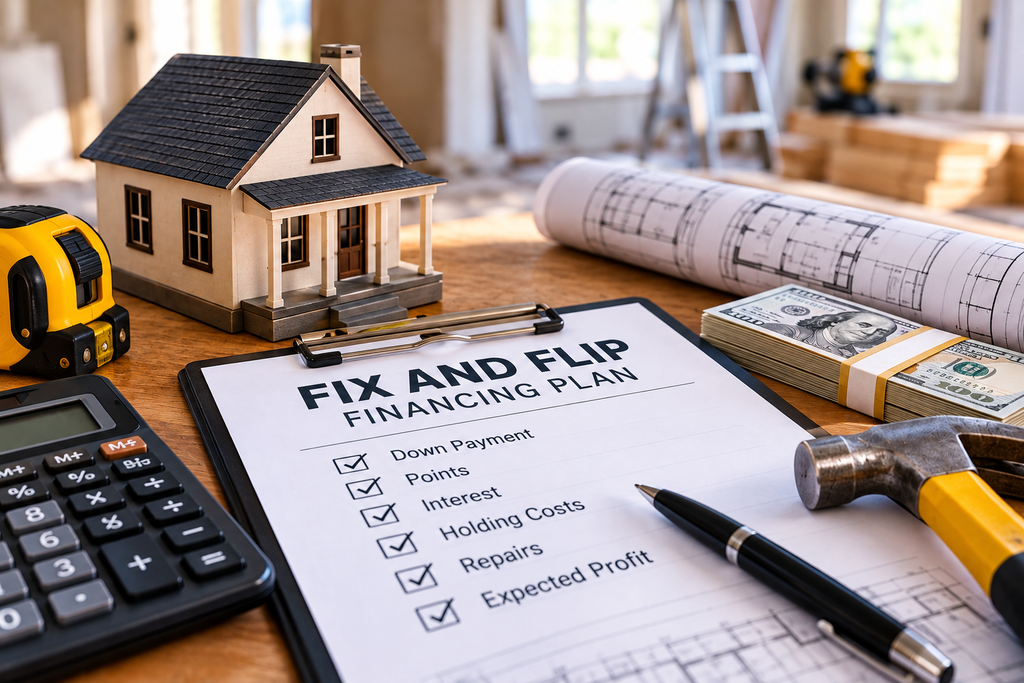
How to Finance a Fix-and-Flip: Down Payments, Points, Interest, and Holding Costs
A fix-and-flip can look like a great real estate investment on paper. You find a property below market value, renovate it, and sell it for a profit. But before you make an offer, there is one critical question: Can you afford to finance the entire project from purchase to resale?
The purchase price and renovation budget are only part of the equation. You also need to account for your down payment, lender fees, interest, insurance, property taxes, utilities, permits, unexpected repairs, and the time it takes to complete the project and sell the property.
If you underestimate these costs, a promising flip can turn into an expensive lesson.
In this guide, we’ll walk through common fix-and-flip financing options, explain the costs investors often overlook, and show you how to build a financing plan before committing to a property.
1. Understand Your Fix-and-Flip Financing Options
Not every lender finances renovation projects, and not every financing product works for every investor. Your experience, credit, available cash, property condition, project timeline, and exit strategy can all affect your options.
Hard money loans
Hard money loans are typically short-term loans secured by real estate. Some lenders focus heavily on the property’s value, purchase price, renovation plan, and expected after-repair value (ARV), while also evaluating the borrower’s financial profile and experience.
Potential advantages include:
- Financing designed for certain investment-property purchases and renovation projects.
- Potentially faster underwriting than some traditional loan programs.
- Funding structures that may account for eligible renovation costs.
Potential disadvantages include higher interest rates, origination points, fees, shorter repayment periods, and possible extension costs.
Ask whether the lender funds only the purchase or also provides renovation funds. If renovation money is available, determine whether it is released upfront or through a draw process after work is completed and inspected.
Private financing
Private financing may come from an individual lender or a private lending company. Terms are negotiated or set under the lender’s program and can vary substantially.
Before accepting a private loan, confirm the interest rate, fees, maturity date, collateral, default provisions, and repayment requirements in writing. Have a qualified real estate attorney review complicated agreements.
Portfolio or specialized renovation loans
Some banks and specialized lenders offer financing for investment properties or renovation projects that do not fit a standard mortgage program.
These options may be worth comparing if you have an established banking relationship, a more complex project, or a longer-term investment plan. Availability and underwriting requirements vary.
Cash or a combination of funding sources
Some investors use their own cash for the purchase and renovations. Others combine cash with financing.
Using cash avoids interest on the amount you do not borrow, but it does not make the project cost-free. Your money is tied up until you sell or refinance, and you still need adequate reserves for overruns and delays.
The goal is not simply to obtain financing. It is to secure financing that fits the project and gives you a realistic path to repayment.
2. How Much Down Payment Will You Need?
Down-payment requirements depend on the lender, loan product, property, borrower, and project.
Some lenders calculate their maximum loan based on a percentage of the purchase price, while others also consider the property’s after-repair value and the renovation budget. A lender may impose limits based on the lower of several valuation measures.
Never assume a lender will finance the entire purchase and renovation.
Example: Buying a property for $200,000
Suppose a lender offers to finance 85% of the purchase price, subject to its underwriting requirements.
| Item | Amount |
|---|---|
| Purchase price | $200,000 |
| Illustrative loan at 85% | $170,000 |
| Your purchase-price contribution | $30,000 |
That $30,000 is only the contribution toward the purchase price in this example. It does not include points, closing costs, renovation expenses, interest payments, holding costs, or reserves.
You may need substantially more cash available to complete the project.
Also, a lender’s loan-to-value calculation is not necessarily the same as its loan-to-cost calculation. Ask which method determines the maximum amount you can borrow.
3. Understand Loan Points and Origination Fees
One cost that can surprise new investors is the number of points charged by a lender.
A loan point is generally equal to 1% of the loan amount when used to describe an origination or discount point. The loan agreement and fee disclosure will specify how the charge is calculated.
Example: A loan with two points
Suppose you borrow $170,000 and the lender charges two points.
- Loan amount: $170,000
- Points: 2%
- Cost of points: $3,400
That $3,400 is an additional financing expense, unless the lender’s structure specifies otherwise. Other charges may apply as well.
When comparing lenders, ask for a written breakdown of:
- Origination points and fees.
- Interest rate and payment requirements.
- Appraisal and inspection charges.
- Title and settlement costs.
- Loan underwriting or processing fees.
- Draw or inspection fees for renovation funding.
- Extension fees and prepayment provisions.
A loan advertising a lower interest rate may not be the least expensive option once points and other fees are included.
4. Calculate Interest Before You Buy
Interest is one of the most important costs in a fix-and-flip because the project may not generate income while you own it.
Some short-term loans require monthly interest payments. Others may structure payments differently, so confirm exactly how interest accrues and when payments are due.
For a simplified interest-only estimate:
Estimated interest = Loan balance × Annual interest rate × Time in years
Suppose you borrow $170,000 at an illustrative annual interest rate of 12% and carry the full balance for six months.
- Loan balance: $170,000
- Annual interest rate: 12%
- Holding period: 6 months
Estimated interest:
$170,000 × 12% × 0.5 = $10,200
This example assumes the full loan balance remains outstanding for six months at a constant rate. Actual interest may differ because of payment timing, changing balances, fees, draw schedules, and the lender’s calculation method.
If the project takes nine months instead of six, the same simplified calculation produces $15,300 in interest.
That is an additional $5,100 simply from carrying the same balance for three more months.
This is why your timeline matters as much as your renovation plan.
5. Don’t Forget Holding Costs
Holding costs are the expenses you incur while owning the property before it is sold or otherwise exits the project.
These costs can continue even when construction stops or the property is not generating income.
Common holding costs include:
- Property taxes.
- Property insurance appropriate for the vacant or under-renovation property.
- Utilities.
- Lawn care, snow removal, and property maintenance.
- Security and protection against damage.
- Homeowners association dues, if applicable.
- Interest and other loan payments.
- Permit-related expenses or required inspections.
Make a monthly holding-cost estimate before purchasing the property.
For example, suppose your non-interest holding expenses total $1,200 per month. If the project takes six months, those expenses total $7,200. If it takes nine months, they total $10,800.
That difference of $3,600 can reduce your profit.
These figures are hypothetical. Your actual costs will depend on the property, location, financing structure, insurance requirements, and project duration.
6. Build a Complete Renovation Budget
A renovation budget should be based on the work the property actually needs, not on a rough guess based on its appearance.
Before purchasing, consider having qualified contractors inspect the property and provide written estimates. Depending on the home, additional inspections may be necessary for the roof, foundation, plumbing, electrical systems, HVAC, sewer line, drainage, or other major components.
Include:
- Labor and materials.
- Demolition and debris removal.
- Permits and inspections.
- Required code-related work.
- Contractor allowances and exclusions.
- Material delivery and disposal.
- Unexpected repairs.
- A contingency reserve.
A contingency reserve helps protect against unforeseen expenses. The appropriate amount depends on the age, condition, scope, and uncertainty of the project. Older properties and major renovations may require more flexibility than cosmetic updates.
Do not assume that a contractor’s estimate covers every potential problem. Ask what is included, what is excluded, how change orders are handled, and how payments will be scheduled.
7. Example: Calculate the Cost of a Fix-and-Flip
Let’s put the numbers together using a hypothetical property.
Assume you purchase a home for $200,000, renovate it, and plan to resell it for $290,000.
| Project item | Illustrative amount |
|---|---|
| Purchase price | $200,000 |
| Renovation budget | $30,000 |
| Purchase closing costs | $4,000 |
| Loan points and fees | $4,000 |
| Interest | $10,200 |
| Taxes, insurance, utilities, and other holding costs | $7,200 |
| Selling costs | $20,300 |
| Total estimated project costs | $275,700 |
| Projected proceeds before income taxes | $290,000 |
| Estimated profit before income taxes | $14,300 |
This example assumes the selling costs are a combined estimate. Actual selling expenses depend on the transaction, brokerage arrangements, transfer taxes, closing charges, concessions, and other terms.
It also assumes the renovation budget is sufficient and the property sells for the projected price. It does not include every possible cost or tax consequence.
Notice that a $90,000 difference between the purchase price and resale price does not mean a $90,000 profit. Financing, renovation, holding, and transaction costs consume much of that difference.
A modest overrun could reduce the estimated $14,300 profit substantially.
Before making an offer, calculate your expected profit using realistic numbers and then test what happens if the project costs more or sells for less.
8. What Happens If the Flip Takes Longer Than Expected?
Delays can come from many sources:
- Permit approvals.
- Contractor availability.
- Material shortages or delivery problems.
- Unexpected structural or mechanical repairs.
- Failed inspections or additional required work.
- Buyer financing issues.
- Appraisal concerns.
- Longer-than-expected marketing time.
For a financed project, delays can mean additional interest, taxes, insurance, utilities, and potentially lender extension fees.
Build multiple timelines into your analysis rather than assuming everything goes according to plan.
For example, calculate the expected profit if the property sells in six months, then again at nine months. Also consider what happens if you need to reduce the resale price to attract a buyer.
If the deal only works under perfect conditions, it may not be a deal worth pursuing.
9. Have an Exit Strategy Before You Close
Your exit strategy is how you intend to repay the financing and realize the investment’s outcome.
For a fix-and-flip, the expected exit is usually selling the renovated property. However, you should understand what you would do if the market changes or the property does not sell on schedule.
Questions to consider include:
- Can you make the loan payments if the property takes several extra months to sell?
- Could you sell at a lower price and still repay the loan and closing costs?
- Would the property qualify for long-term rental financing if you decide to hold it?
- Would the projected rent support the costs of keeping it?
- What financing would be available if you needed to refinance?
- Does your lender permit the proposed exit strategy, and what happens if you cannot repay by maturity?
Do not assume you can refinance into a rental loan. Eligibility, appraisal value, credit, rental income, seasoning requirements, and market conditions can all affect your ability to refinance.
A backup plan does not guarantee a successful outcome, but it can help you identify risks before committing your capital.
10. Questions to Ask a Fix-and-Flip Lender
Before signing a loan agreement, get clear answers to the following:
- What is the maximum loan amount, and is it based on purchase price, loan-to-cost, after-repair value, or another calculation?
- How much cash must I contribute to the purchase and renovation?
- Are renovation funds released upfront or through draws?
- What documentation and inspections are required before renovation funds are released?
- What are the interest rate, points, origination fees, and other closing costs?
- When are interest payments due, and how is interest calculated?
- What is the loan maturity date?
- Are extensions available, and what do they cost?
- Are there prepayment penalties or other early-payoff restrictions?
- What happens if the project goes over budget or cannot be completed on schedule?
- What property insurance and other protections are required?
- What happens if I cannot repay the loan on time?
Request the terms in writing. For complex financing or unfamiliar contract provisions, consider having a qualified real estate attorney review the agreement before signing.
Your Fix-and-Flip Financing Checklist
Before making an offer, make sure you can answer these questions:
- I have a realistic purchase and renovation budget.
- I have confirmed the lender’s actual down-payment and loan requirements.
- I have calculated points, fees, and estimated interest.
- I have budgeted property taxes, insurance, utilities, and other holding costs.
- I have obtained appropriate contractor estimates and considered inspections.
- I have included a contingency reserve.
- I have estimated selling expenses and a realistic resale price.
- I have calculated profit under a delayed-sale or lower-price scenario.
- I have enough cash to handle payments and unexpected expenses.
- I understand the loan maturity date and my repayment plan.
The Bottom Line: Finance the Entire Project, Not Just the Purchase
Successful fix-and-flip investing requires more than finding a property that appears undervalued. You need a realistic renovation plan, a clear understanding of financing costs, enough cash to carry the project, and an exit strategy that still works when circumstances change.
The best time to uncover a financing problem is before you buy—not when your loan is coming due and the renovation is unfinished.
Do your calculations, compare lenders, verify the property condition, and stress-test the numbers. A disciplined financing plan can help you distinguish a promising opportunity from a risky purchase.
Join the Northern Illinois Investor Connection
Looking for your next investment opportunity in the Southwest suburbs, Northwest suburbs, or greater Chicagoland area?
Join the Northern Illinois Investor Connection to share your investment criteria and receive information about potential properties that may fit your goals.
Joining is free. Your registration information will be treated confidentially and will not be sold. Registration does not guarantee property availability, financing approval, or investment results.
Disclaimer
This article is for general educational purposes only and is not financial, legal, tax, lending, construction, or investment advice. Financing terms, costs, property conditions, and resale outcomes vary. All figures are hypothetical illustrations, not lender quotes or guaranteed results. Consult qualified lending, legal, tax, and construction professionals before making investment or financing decisions.